Railroads have always played a crucial role in the development of civilization. They connect cities and countries, transport cargo and passengers, and form entire economic systems. But very often there is confusion in speech: some people say “train” and others say “locomotive”, implying the same thing. In fact, these are two different concepts, and understanding the differences between them helps to better navigate the topic of railway transportation.
What is a train?
A train is a complete system consisting of several interconnected parts. Its main task is the transportation of passengers or cargo. In the usual sense, a train is a chain of cars pulled or pushed by a locomotive. However, modern rail transportation is more complex: today there are different types of trains, including self-propelled trains, where the traction function is distributed over the entire train.
A train can be considered as a transportation unit, where each element has a specific role:
- Passenger cars – equipped with seats or sleepers, sometimes with additional services like restaurant, buffet, air-conditioning; they provide comfortable and safe travel for people over different distances.
- Freight wagons – tanks, platforms, boxcars and gondola cars designed for transportation of various goods: from coal to cars; their design is chosen depending on the type of cargo and transportation conditions.
- Service cars are for conductors, technical personnel, sometimes for cargo security; they play the role of an operational center, where inventory is stored and control over the train is ensured.
Thus, a train is always a combination of several modules assembled in a single system to perform a transportation task; the composition of these modules determines the purpose of the train, its speed, capacity and technical characteristics.
What is a locomotive?
A locomotive is the mechanical basis for the movement of a train, its engine and “muscle”. Its primary purpose is to provide traction and propel a train of cars. The locomotive itself does not normally carry passengers or freight, except for the driver and maintenance personnel.
Historically, locomotives were steam locomotives, followed by diesel and electric locomotives. Today, several main types are distinguished:
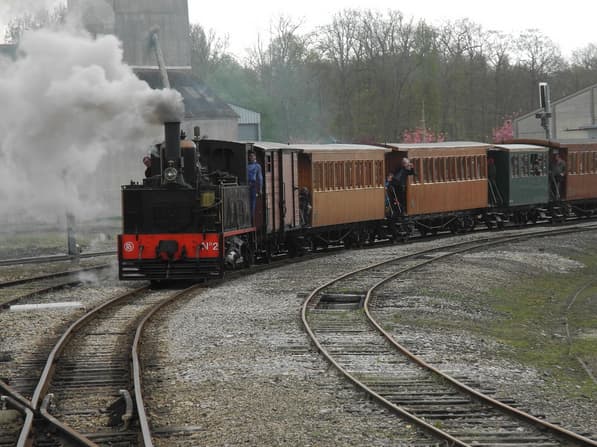
- Steam locomotives were the first locomotives to be powered by steam from boiling water heated by coal or wood, and they came to symbolize the beginning of the railroad era.
- Diesel locomotives – liquid-fueled machines that displaced steam locomotives in the mid-20th century due to their reliability and lower operating costs.
- Electric locomotives – locomotives powered by catenary or built-in batteries, characterized by high power and environmentally friendly operation.
- Hybrid and battery locomotives are a modern class of traction machines that combine different energy sources and reduce emissions and fuel costs.
It is important to realize that a locomotive does not exist “for its own sake” – its task is always connected with the train. Without cars, the locomotive does not perform its transport function, it is just a machine without cargo.
Key functional differences
To more clearly show the difference between the concepts of “train” and “locomotive”, let’s break it down by key criteria.
- Purpose: A train is used as a means of transportation to deliver passengers and goods, while a locomotive performs solely the function of traction and propulsion.
- Composition: A train is a combination of wagons and, if necessary, several locomotives, while a locomotive is always an independent machine.
- Traction: The locomotive is always equipped with its own propulsion system, while the train can move without a separate locomotive by means of motorized wagons.
- Cargo carried: a train is used to transport people and goods, while a locomotive carries only the driver and technical equipment.
- Flexibility of configuration: a train can vary in length and include dozens of cars, while a locomotive remains limited by its design and size.
This difference is evident if you think of the train as a system and the locomotive as its engine; it is the interplay of these two concepts that allows rail transport to perform long-distance transportation tasks in an efficient and organized manner.
Historical perspective and evolution
The history of railroad transportation is the history of the development of locomotives.
- The beginning of the XIX century was the era of steam locomotives. In 1804 Richard Trevithick built the first operational steam locomotive, and in 1829 George Stephenson introduced his famous “Rocket”. These machines were able to carry freight and passengers faster and more efficiently than track transportation.
- The middle of the 20th century was marked by the transition to diesel and electric locomotives. Steam locomotives were gradually becoming a thing of the past, as they were labor-intensive to maintain and inefficient.
- Modernity brings new technologies: battery-powered locomotives that run on batteries and hybrid models that combine different energy sources.
In parallel, the train itself was also changing. If earlier the train consisted of cars, which were necessarily pulled by a locomotive, now there are self-propelled trains – electric trains, subways, high-speed trains, where traction motors are built right into the cars.
Modern technologies – from batteries to distributed traction
Two interesting development trends can be identified in the railroad industry today.
- Battery-powered locomotives. They are becoming especially popular in countries where it is important to reduce carbon dioxide emissions. These vehicles are quieter, save fuel and require less maintenance. This is still an experiment for freight transportation, but battery-powered trains are already being actively introduced in passenger transportation.
- Distributed traction. Traditionally, the locomotive was located at the front of the train, but modern technology makes it possible to distribute traction to different wagons or add locomotives to the middle and end. This makes the movement more stable, reduces the load on the couplers and allows longer trains to be operated. This is especially important for heavy freight routes, such as transporting ore or coal over thousands of kilometers.
Bottom line
To summarize:
- A train is a complex transportation unit whose main purpose is to transport passengers or freight.
- The locomotive is the engine and source of power that ensures the movement of the train.
- A train without a locomotive (in the classical sense) is immobile, and a locomotive without cars is just a traction machine without a payload.
- Historically, it was the locomotive that became the symbol of the railroad, but in modern conditions we more and more often meet trains where traction is built into each car.